Authors: Anastassiya Tchaikovsky, Johanna Irrgeher, Andreas Zitek, Dieter Garbe-Schönberg, Thomas Prohaska
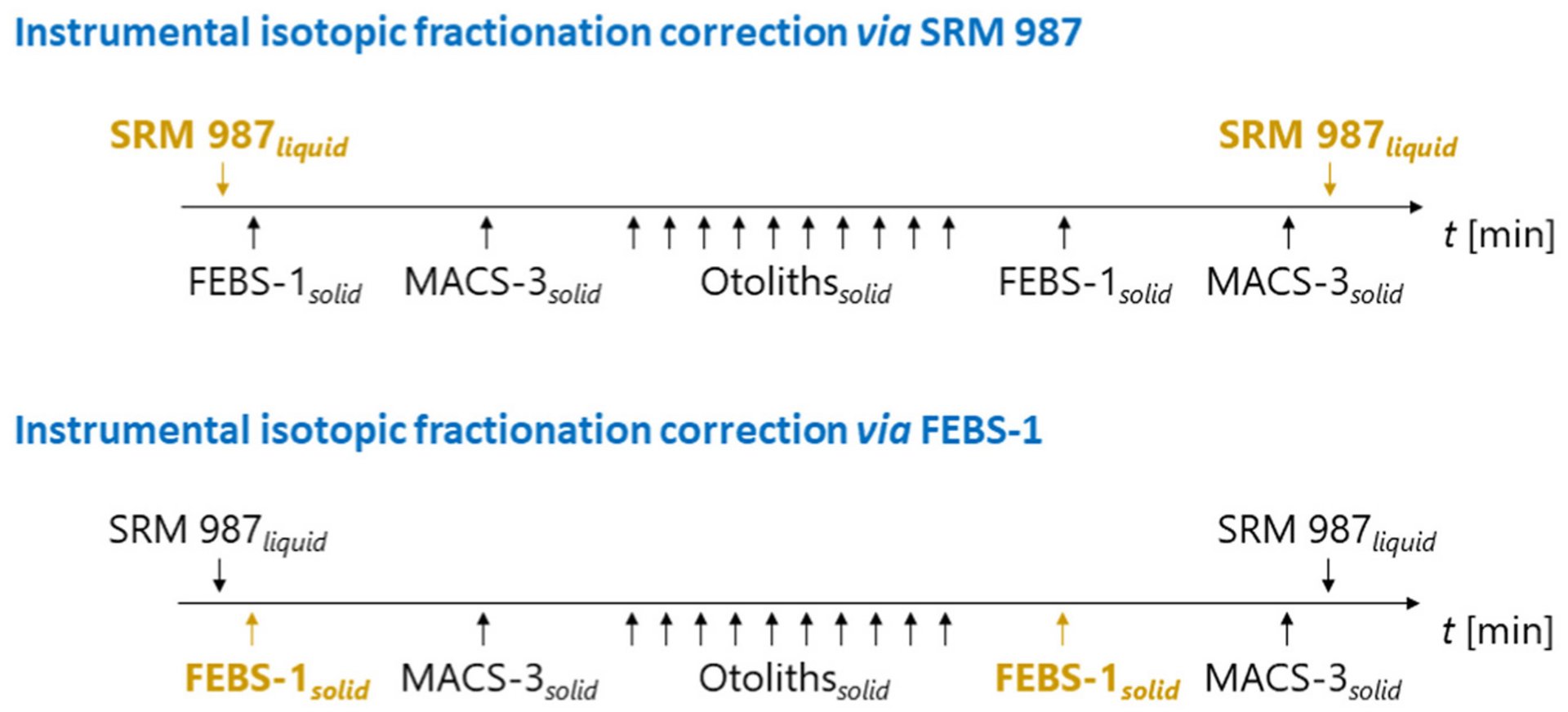
Abstract: The determination of the spatial variation of n(87Sr)/n(86Sr) isotope ratios in calcium carbonates by laser ablation multi collector inductively coupled plasma mass spectrometry (LA-MC-ICP-MS) can support to uncover geological, ecological, or biological processes. This study presents the use of an external matrix matched bracketing standard for the correction of instrumental isotopic fractionation (mass bias) of strontium isotope ratios in natural carbonates determined by LA-MC-ICP-MS. We used a stable, homogeneous and well-characterized reference material, the FEBS-1 otolith powder, pressed into pellets as a matrix matched calibration standard. Pellets were produced without binder by means of a hydraulic press and nano-milling to improve the mechanical stability and homogeneity of the pellet. The methodology was applied to fish otoliths, which represent a typical natural carbonate matrix of high interest. The synthetic carbonate powder MACS-3 pressed into pellets was used as quality control standard. The tested performance indicators of the methodology were robustness, trueness and precision. Using the conventional method up to 20 % of quality control data showed a significant unsystematic bias and all otolith isotope ratio data shifted in comparison to the expected values by up to 0.00068. The novel approach eliminated the unsystematic bias in quality control data and reduced the shift of otolith n(87Sr)/n(86Sr) isotope ratios by up to 100 %, thus significantly improving method robustness and data trueness. The precision of the n(87Sr)/n(86Sr) isotope ratio in the investigated natural carbonates amounted to approximately ± 0.00033 (1 SD) and was comparable to similar experimental studies in this field.