Authors: Stephanie Adler, Martin Martschini, Thomas C. Meisel, Peter Steier, Alexander Wieser, Karin Hain
Abstract
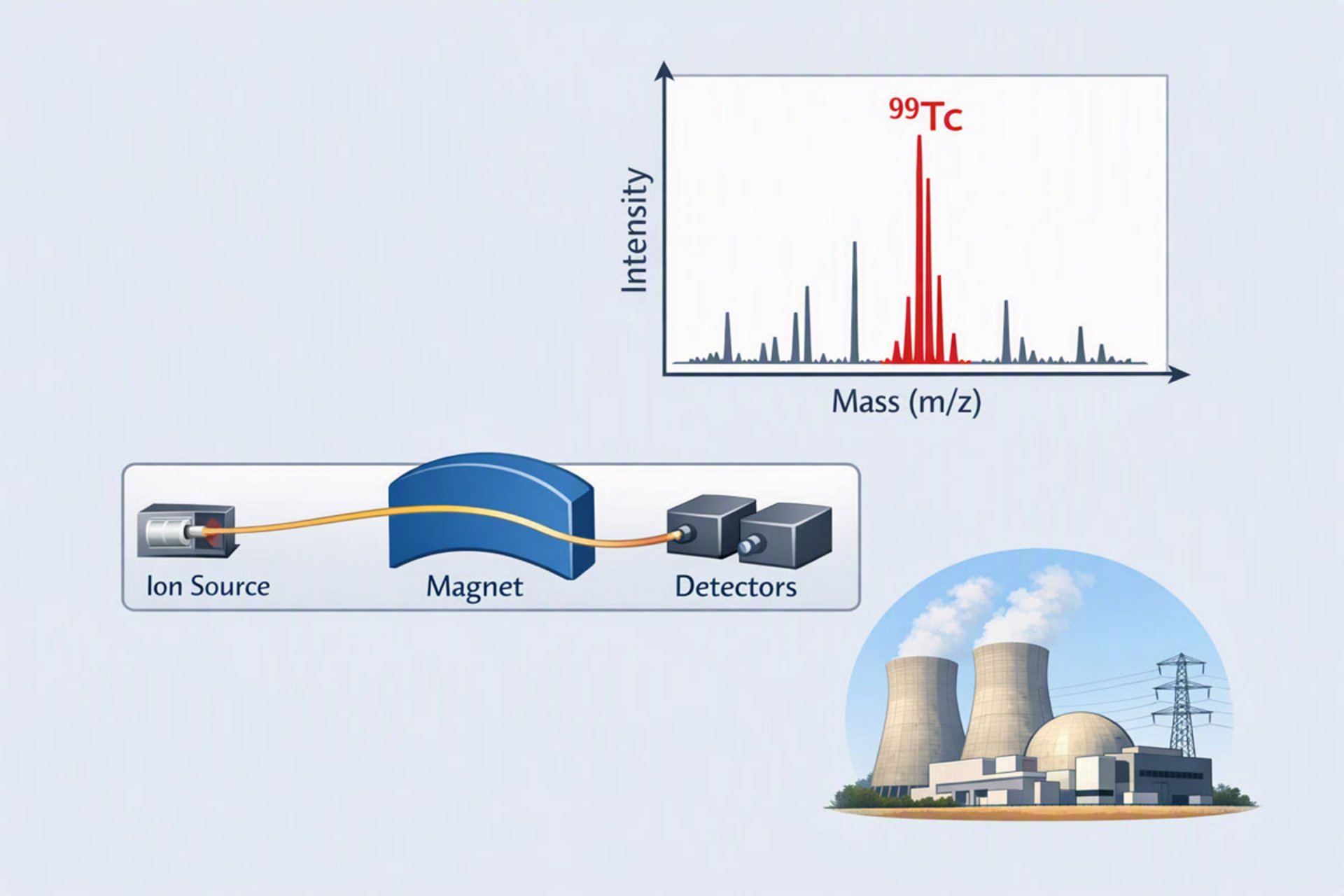
Quantifying the long-lived fission product 99Tc (𝑡1/2=2.111×105 yr) in environmental samples at global fallout levels (down to 106 atoms per L) remains challenging. Beyond suppressing the stable isobar 99Ru, establishing a robust normalization method is a major challenge for mass spectrometric analysis of 99Tc. We aim to benchmark two complementary approaches: in Accelerator Mass Spectrometry (AMS) we investigated non-isotopic normalization to the Nb-current extracted from the sample matrix in a Cs-sputter source, for extraction of the monoxide (TcO−) and pentafluoride (TcF−5) anions from the ion source at the Vienna Environmental Research Accelerator (VERA). The reproducibility of this non-isotopic normalization is sensitive to ion source operating conditions and ranges from 10%–30% (monoxide) and 20%–60% (pentafluoride). Ionization efficiencies of 99TcO− and 99TcF−5 are reported for the first time as 0.4% and 0.03%, respectively. In parallel, we explored the feasibility of normalization using a 97Tc spike in negative Thermal Ionization Mass Spectrometry (n-TIMS), for which the ionization efficiency of 99TcO−4 was determined to be 2%–10%. The suppression of 99Ru and 97Mo in n-TIMS was quantified for the first time, yielding upper-limit suppression factors of >7×10⁵ and >5×10⁴ relative to Tc, respectively.
https://www.sciencedirect.com/science/article/pii/S0168583X2600279X#fig5