Authors: Stefan Wagner, Antonia Siebenbrunner, Amauri Antonio Menegário, Ulrike Moser, Thomas Prohaska, Tea Zuliani, Gorazd Žibret, Johanna Irrgeher
Abstract
Background
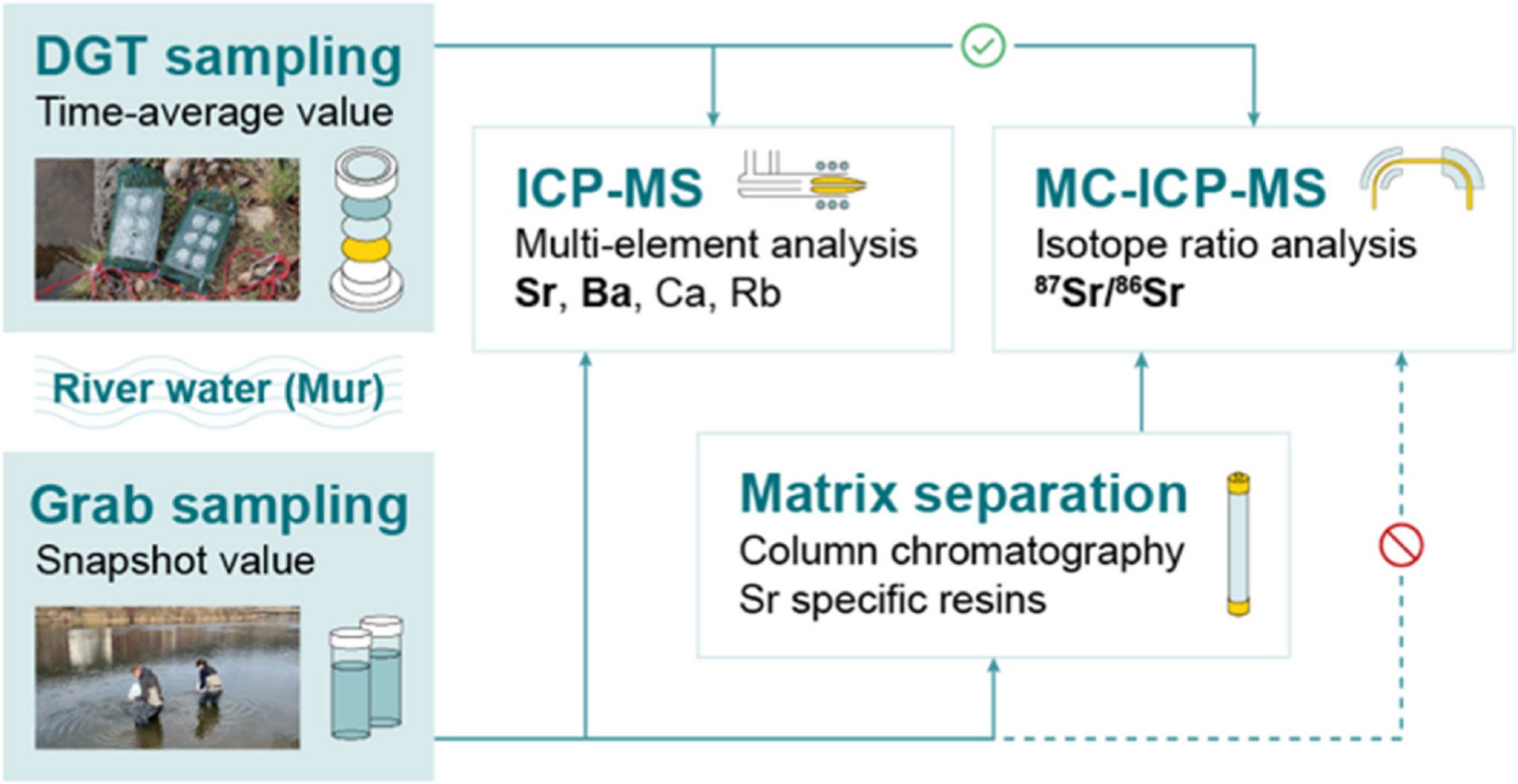
Assessing representative baselines of labile strontium (Sr), barium (Ba), and radiogenic Sr isotope ratios (87Sr/86Sr) in dynamic freshwaters remains challenging because conventional grab sampling provides only time-specific snapshots. Here, we present a novel diffusive gradients in thin-films (DGT) passive sampling technique using a crown-ether/organophosphorus-functionalized binding layer (TK100 membrane), combined with inductively coupled plasma mass spectrometry (ICP-MS), for the simultaneous, time-integrated determination of these biogeochemical tracers in natural freshwaters.
Results
Laboratory evaluation showed quantitative Sr and Ba uptake by the TK100 membrane (fu = 100 %), low method detection limits (xL ≤ 0.07 μg L−1, t = 7 d), and linear accumulation in 0.45 μm-filtered river water over time (t = 1–7 d). Three-step elution using HCl provided high total Sr and Ba elution efficiencies (fe ≥ 95 %) and reduced Ca/Sr and Rb/Sr ratios by up to ∼20-fold and ∼250-fold, respectively, relative to grab samples. This enabled 87Sr/86Sr analysis of DGT eluates by multi-collector ICP-MS without offline preconcentration or matrix separation. Field deployments at two sites in the Mur River, Austria, showed no significant 87Sr/86Sr bias relative to grab samples and provided time-averaged labile Sr and Ba concentrations and 87Sr/86Sr ratios over the deployment period (t = 4–7 d).
Significance
The results establish TK100 DGT as an integrated passive sampling tool for labile Sr, Ba, and 87Sr/86Sr, combining time integration, selective uptake, preconcentration, and matrix reduction in a single deployment. The method complements grab sampling and supports representative baseline monitoring and hydrogeochemical tracing of Sr and Ba in the environment.